




How To Adjust The Colloid Mill To Be Finer?
 Dec 12, 2024|
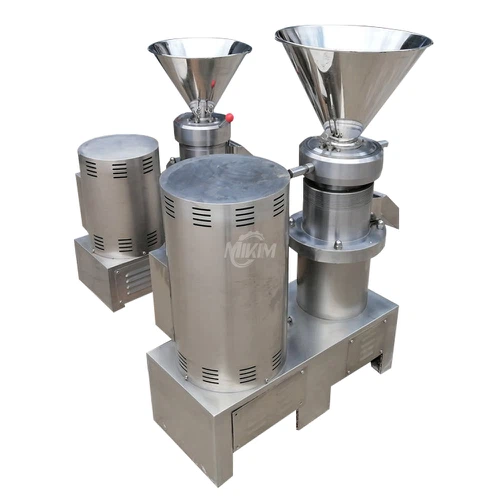
 Adjust the grinding disc gap: Turn the adjustment handle, and the adjustment ring drives the stator to move axially, thereby changing the gap. The specific operation is to loosen the two handles slightly first, then turn the adjustment handle clockwise, stop when you feel a little friction, and then reverse the ring to make the grinding head gap greater than 0, and tighten the handle on the adjustment ring after adjusting the fineness.
Adjust the grinding head position: Moving the grinding head counterclockwise upward will make the fineness coarser, while moving it clockwise downward will make the fineness finer.
| Model | LH-80 | LH-110 | LH-130 | LH-180 | LH-240 | LH-300 |
| Capacity ( t/h) | 50-60 | 150-200 | 300-400 | 600-700 | 1000-1500 | 2000-2500 |
| Main power (KW) | 4 | 7.5 | 11--15 | 18.5/22 | 37/45 | 75/90 |
| Dimension | 520 | 685 | 700 | 975 | 981 | 1319 |
| (mm) | ||||||
| Width | 335 | 430 | 456 | 476 | 500 | 630 |
| Height | 928 | 1000 | 1054 | 1124 | 1276 | 1420 |
| Weight (kg) | 210 | 300 | 400 | 420 | 1000 | 1600 |
Start-up grinding adjustment: When starting the machine to grind materials, you need to loosen the two handles slightly first, then turn the adjustment handle clockwise, stop when you feel a little friction, and then reverse the ring to make the grinding head gap greater than 0, and tighten the handle on the adjustment ring after adjusting the fineness.
Notes: Generally, if the requirements for the fineness of the processed material are met, the gap between the grinding discs should be as large as possible, or the gap should be increased for cyclic grinding first, and then the gap should be gradually reduced, so as to increase the service life of the grinding head.
The working principle of the colloid mill is that the motor drives the rotating teeth and the fixed teeth to rotate at a high speed relative to each other. The material generates a downward spiral impact force through its own weight or external pressure. When passing through the gap between the fixed and rotating teeth, it is subjected to strong shear force, friction force, high-frequency vibration, high-speed vortex and other physical effects, so that the material is effectively emulsified, dispersed, homogenized and crushed.