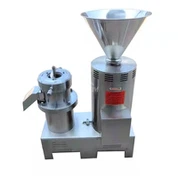
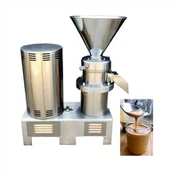
Automatic Jam Making Machine
model
50 85 130
power
1.5kw 5.5kw 7.5kw
speed
2900r/min 2900r/min 2900r/min

- Product Introduction
Peanut butter milling machine

Before cleaning the colloid mill, the equipment needs to be prepared. First, turn off the power of the equipment, and then remove the important parts of the colloid mill, such as grinding discs, grinding beads, etc. Check whether these parts are clean and clean them for the next production.
If you are cleaning new equipment or important parts, it is recommended to use a professional cleaning agent. If you are cleaning old equipment or daily cleaning, you can use ordinary cleaning agents. Adjust the density of the cleaning agent to the appropriate concentration, add enough water, and stir it thoroughly. It should be noted that the temperature of the cleaning solution is generally kept between 40℃-60℃.
Inject the cleaning solution into the equipment and turn on the circulation pump to ensure that the cleaning solution can flow through all parts of the equipment. Set the circulation time to 10-30 minutes to ensure that the cleaning solution can fully clean the inside of the equipment and remove the dirt.
Stop the cleaning solution circulation pump, drain the cleaning solution, and then rinse with clean water. The rinsing time is generally 5-10 minutes. After rinsing, use a clean towel or water absorber to drain the water.
Put the equipment parts in a ventilated place to dry. You can use auxiliary tools such as drying racks or fans, and wipe the outside and inside of the equipment clean. Make sure all parts are completely dry before reinstalling them into the equipment.

| model | capacity | power | No-load speed | size |
| 50 | 0.005-0.3t/h | 1.5kw | 2900r/min | 600*300*700mm |
| 85 | 0.2-2t/h | 5.5kw | 2900r/min | 800*350*950mm |
| 130 | 0.2-4t/h | 7.5kw | 2900r/min | 900*400*1000mm |
| 180 | 0.8-6.0t/h | 15kw | 2900r/min | 1100*500*1100mm |
| 210 | 4-15t/h | 22kw | 2600r/min | 1200*500*1400mm |
Peanut butter mixer machine
1. When the colloid mill is out of use, shut down the machine and cut off all power supplies, then rinse the residual materials in the machine with clean water.
2. Remove the hopper, discharge pipe, discharge nozzle, rotating teeth, fixed teeth and gap adjustment sleeve in turn and clean them.
3. It is recommended to use other small tools, such as brushes or tweezers, to better clean the waste residues in the tooth gaps and grooves, and then rinse them with clean water.
4. For removable parts, it is recommended to clean the surface of the parts with a cleaning agent, pay special attention to the cleaning of the gaps, then rinse with clean water and dry naturally.
5. For the parts of non-removable parts, first flush the waste residues in the grinding seat groove with clean water, then use a brush dipped in a cleaning agent to brush the grinding seat groove and rinse it clean.
6. After the outer surface of the main part is scrubbed with a cleaning agent. Wipe with a clean damp cloth to remove the residual cleaning agent on the outer surface, and then wipe it again with a dry cloth.

1. When installing, the colloid mill should be installed horizontally on a flat concrete foundation.
2. Before grinding the material, debris should be removed, the material particle size should be less than 1mm, and the material hardness should not be higher than HV309.
3. After the colloid mill is connected to the circuit and the power supply, it should be noted that the direction of rotation of the rotor should be consistent with the direction of the arrow on the base.
4. The colloid mill should not be turned on and idle for more than 15 seconds to avoid damage to the machine body.
5. Before using the colloid mill, turn the rotor to check whether it is in contact with the stator and whether it is stuck.
6. When starting the motor of the colloid mill, check whether there is noise or vibration.
7. The colloid mill cannot process dry solid materials and can only perform wet processing.
8. It is strictly forbidden to allow hard objects such as iron and gravel particles to enter the grinding core to prevent damage to the machine.
9. After using the colloid mill, the colloid mill needs to be cleaned to avoid material residue and cause machine seal leakage.

Our Advantages
150
+
Number Of Employees
3000㎡+
Factory Area
10
+
Years Of Experience
800㎡+
Company Area
Peanut butter press machine
Jam maker machine disassembly and installation
1. The disassembly process of jam processing machine needs to start from the top of the feed port of the colloid mill. First check the fixings of the inlet bucket, use special tools to remove the two studs, and remove the inlet bucket. Some inlet buckets can be rotated and disassembled, so it is more convenient to disassemble.
2. Remove the inlet bucket, remove the middle ring of the lower layer, rotate the handle on the grinding disc counterclockwise, pull up the static grinding disc (stator), and remove the grinding disc.
3. Then operate the material pushing device counterclockwise and remove the pushing device
4. Use special tools to turn the screw fixings, hold and pull the grinding disc (rotor), and remove it.
Qualification & Honor

Customer visits

Hot Tags: automatic jam making machine, China automatic jam making machine manufacturers, factory, Pork Cutter Machine, meat cutting machine, Meat Cutting Machine for Restaurant, Fully Automatic Meat Slicer, Groundnut Butter Machine, peanut butter warehousing system